

“Am I burnt out or just lazy?”
Chris explores why people who worry about being lazy rarely are, and what the science says about it. He reflects on his own lost love of playing guitar to shine a light on how a hobby can start to feel like a chore. The post also examines how performance has become a normal part of our lives, and how that can lead to burnout.
How performance culture can turn your hobbies into chores.

At first glance, this question seems odd. Surely burnout and laziness are polar opposites? Nope, there’s way more nuance to it which we will explore. One thing I can tell you up front though: if you’re worried about being lazy to the point that you’re reading about it, you’re probably not lazy.
When I was a teenager my world revolved around music. My €5 per hour job in a nearby sports shop was almost exclusively for financing music equipment. Microphones. Guitar effects. Guitars. Today, that gear has either been sold or has become decoration. My favourite guitars were not sold and now adorn my sitting room. I walk past them roughly 20 times a day to get to the kitchen. How often do I pick one up? I’d have to invent a number. Maybe once every 4 months? And only for 20 minutes or so. How did it come to this? Had I become lazy?
What really happened is that playing guitar had become a chore in my mind.
To get to the bottom of this we have to talk about motivation because a lazy person doesn’t feel guilty about breaking up with music.
How can a hobby become a chore?
When the motivation to do something fun is replaced by a feeling of duty, play turns into work. How we view it can completely change.
Can you think of a person you were once close with but now you can’t imagine how that was ever a thing? The way you see that person today is very different to how you saw them at the time. It wouldn’t be unusual if the thing you liked most about them is now what bugs you the most. We all change our minds. Our perceptions develop over time so our mind updates what people, places, things or situations mean to us. That’s also why some people stay friends with their ex and others bury all evidence it ever happened.
An activity itself does not determine if a person will like it or not. Take golf for example. I’m neutral on this because I’ve never played but people seem to either go crazy for it or spend way too much energy arguing that it’s “not a real sport”. In the same way, the activity itself does not determine whether it helps someone switch off. This is backed up by evidence: what recovers you is the experience an activity gives you, more than the activity itself (1).
Let’s take Dylan* for example. Lately he’s been feeling exhausted. Nothing feels fun anymore. Many years ago he was an avid reader. He loved spending time in book shops, staying on top of new releases and eagerly planning what he would read next. Today, reading feels like a chore. He regularly worries that he has become lazy. What’s changed? A lot can change in 10 years but two stand out:
1. He has children now. They have preferences too. Sometimes they want him to read to them, so it’s their book and not his. Sometimes they point blank refuse to go to bed. Other times they wake up just as he has settled in with a chapter. There’s certainly been a change in his decision making. Whether he gets to read tonight is no longer purely his decision. Unless he decides himself to leave the book closed, which can happen too. A choice like that means he won’t read a page but at least the decision is his.
2. He has made reading a chore. The third Dune movie is out soon and he promised himself he’d have read the first two books before the release. He’s got to page 172 of the first book and it’s been gathering dust on his bedside table ever since. For the past three months he’s been scrolling Instagram before bed. The average sleep score on his wearable has been dropping and he can feel it. He refuses to read something different because his rule is “I finish every series I start.” There it is. The inner rule. It’s a personally declared sin to skip this book, so it must get read. That’s what he told himself about the Lord of the Rings trilogy, what’s been released of A Song of Ice and Fire and others (they have since been placed out of sight, just in case). There’s too much pressure. And if that wasn’t enough, he did manage to get through the A Court of Thorns and Roses series with enough skilful persuasion from his significant other (he even surprised himself) and she’s kindly reminded him that the new one is out soon. Joy has turned into performance.
An activity that has a feeling of “should” or “have to” attached delivers less rest and recovery than one that brings joy (2). The feeling of play that’s needed for recovery got lost for Dylan along the way. He had not only lost his passion for books. He had also lost something that would charge his batteries without him realising. Today he even avoids the topic of reading altogether when he’s feeling particularly exhausted because after work, the last thing he wants is “more work”.
Is it avoidance or laziness?
In simple terms, avoidance is when we don’t do something in an attempt to escape from a negative feeling (e.g. guilt, low self-worth or shame). Procrastination is the classic example: you remember there’s an important form you need to fill in by tomorrow evening. You hate any type of bureaucracy so instead you clean the house. This is interesting because a decision was made between two chores. Your flashy Dyson got the upper hand. But I bet that if your friend called you, asking for help with relationship troubles, the Dyson would pull the short straw. Laziness is not part of the equation at all.
To understand why, we’ll use a popular psychology theory as our lens. Self-Determination Theory proposes that we humans have three needs that, when met, make us feel motivated (3):
1. Autonomy: the feeling that what you’re doing is your own choice, and not decided by someone else.
2. Competence: the feeling that you’re capable of doing it well.
3. Relatedness: the feeling that you belong and are connected to other people.
The theory argues that people thrive when all three are met and that motivation weakens when one is missing. It also helps to understand why hoovering suddenly becomes the more interesting chore:
1. The decision feels better than urgent paperwork that found you
2. It’s easy so you’re automatically good at it and get a tangible outcome
3. The outcome is a clean home which can bring you closer to your spouse.
Though technically all three are met, number 3 is the weakest. That's why the Dyson loses the moment your friend calls: the connection on offer is stronger and more immediate.
Let’s use this lens to view Dylan’s lost love for reading. His selection of books is externally motivated: a new release creates the pressure for him to finish a book, and though it was his choice to start the book in the first place, the feeling of autonomy was lost as the book progressed (“I have to read 10 pages every night”). Because his reading habit is nothing like it was when he was younger, he feels a specific kind of loss about his ability to read. He regularly jokes about how social media killed his attention span but behind closed doors he doesn’t feel good about it. The times when he does read, he’s actively connecting with others. Be it when he’s reading ACOTAR with his partner or Paddington Bear to his young kids before bed.
Sometimes he feels conflicted as to why at times reading flows and other times he’s totally blocked. Feeling blocked causes him to avoid reading. To escape feeling like he let himself down. During periods where his avoidance is particularly active, the pattern also trickles into his work: not putting up his hand for that exciting new project or ‘forgetting’ that weekly report in the hopes nobody would notice. For Dylan it feels like an incurable tiredness combined with a general disinterest in things that would normally make him happy. In the little spare time he has, he’s usually scrolling Instagram whilst watching Netflix, which causes him to judge himself harshly for being lazy. In reality he’s slowly burning out because he’s not getting enough quality rest to balance out his responsibilities at home and at work.
Dylan’s rule about finishing what he starts may sound familiar to anyone who has felt not good enough or like a fraud at work. Imposter Syndrome is closely tied to the fear of falling short of perfect and the need to look as if that never happens (4). This fear produces a lot of negative feelings, which can cause a lot of avoidance. The more work that piles up, the more stress does too. This same fear can lead very ambitious people to burn out through excessive worrying and beating themselves up over their own high standards (5). But are those standards truly ours?
How does performance culture affect our lives?
We end up feeling guilty for not doing enough, but nobody ever tells us what enough is. The reminders are everywhere:
Movie marathons
Yearly reading goals
PS5 Platinum trophies
Endless Duolingo streaks
Social media follower counts
Closing your Apple Watch rings
All of the above are scoreboards. Useful tools at first sight, yet double-edged swords in practice: for some they amplify joy, for others they put out the flame. The good thing is that they are all optional.
Researchers argue that on a societal level, the pressure to perform has largely moved from outside to inside (6). Performance has become such a normal part of our daily lives that we blame ourselves for not keeping up with what can be a really inhumane pace. Our inner voices become harsher than any boss because they can never be satisfied. If we believe that the opposite of performing is laziness, it is no wonder that many people call themselves lazy whilst slowly burning out. The saddest part is that they blame themselves, when there’s so much more to it. Sure, we all make our own decisions and we can absolutely steer the ship into better waters. However, that’s pretty difficult to do when we’re not able to see the patterns we are stuck inside of. Apparently there’s no room in the school curriculum for learning how a human works next to algebra and learning how glacial erosion formed valleys eons ago.
The important takeaway is this: it’s not your fault. But you have the power to change it. Both are true at the same time.
On a practical level, the takeaway is simpler: ask yourself what you’re currently doing purely for enjoyment. If nothing comes to mind, you know what to do. Start small. Don’t connect it to a goal. Just do it because it feels good. Do it regularly. For Dylan this might be to start a different book. One he’s been wanting to read but couldn’t give himself permission to read. He’s afraid that he will never get back to reading Dune but that leaves him with two options: pick it back up after the next book or leave it be. If the idea of having read the book is more appealing than actually reading it, it’s likely not worth it.
If restful activities make you feel guilty, try to view them as an important part of your work. The best work comes from well rested people. If even this seems like a mammoth task, I can help you. In my work with clients we find the exact reason they feel blocked and address it at the source. That doesn’t require a childhood deep dive because what matters in my work is who you are today.
Which brings me back to my guitars. I recently realised that at some point I must have tied music to performance. Back in 2009 I wanted to give YouTube a stab. In hindsight, it’s not surprising that I was dealing mostly with crickets. I continued recording songs and uploading videos until my young self ultimately got disheartened and gave up amidst life’s pressures picking up. My mindset is totally different to what it was back then. However, I am clearly still carrying the bad feelings I picked up back then. The guitars are the daily reminder my eyes have become trained to no longer see. There’s still some inner work for me to do before we can get back together.
Important: There are multiple stages of burnout and if you feel yours has advanced to the point where you’re feeling totally out of control, the first step is to consult a GP.
Are you saying yes to more work when you’re already at capacity? If you feel like you’re always exhausted because you find it really hard to say no, try my free diagnostic. It takes under 10 minutes and reveals why you say yes and what it’s costing you. It’s called Say Yes and Mean it.
About the author - Chris Baeuchle
MSc Personal & Management Coaching, UCC
7+ years tech leadership (Apple, Indeed, komoot)
International Association of Mind Coaches
*Dylan is a fictional character. His story reflects patterns I regularly see in my work.
Sources:
(1) Sonnentag, S., & Fritz, C. (2007). The Recovery Experience Questionnaire: Development and validation of a measure for assessing recuperation and unwinding from work. Journal of Occupational Health Psychology, 12(3), 204–221. https://doi.org/10.1037/1076-8998.12.3.204
(2) ten Brummelhuis, L. L., & Trougakos, J. P. (2014). The recovery potential of intrinsically versus extrinsically motivated off-job activities. Journal of Occupational and Organizational Psychology, 87(1), 177–199. https://doi.org/10.1111/joop.12050
(3) Ryan, R. M., & Deci, E. L. (2000). Self-determination theory and the facilitation of intrinsic motivation, social development, and well-being. American Psychologist, 55(1), 68–78. https://doi.org/10.1037/0003-066X.55.1.68
(4) Hill, A. P., & Gotwals, J. K. (2025). A meta-analysis of multidimensional perfectionism and impostor phenomenon. Journal of Research in Personality, 118, Article 104639. https://doi.org/10.1016/j.jrp.2025.104639
(5) Hill, A. P., & Curran, T. (2016). Multidimensional perfectionism and burnout: A meta-analysis. Personality and Social Psychology Review, 20(3), 269–288. https://doi.org/10.1177/1088868315596286
(6) Bogaerts, S., Chasiotis, A., Klaiber, P., Bechara, J., Abrahams, L., Piyasinchai, B., Junker, T., Hoedjes, M., Stone, L., Janković, M., & Masthoff, E. (2026). Alienation in modern culture: A psychoanalytic analysis of five societal transitions. Human Arenas, 9(Suppl. 1), 39–61. https://doi.org/10.1007/s42087-025-00549-z

"Should I apply if I don't meet every job requirement?" is the wrong question
Chris explains why job seekers put off applying, drawing on his time as a hiring manager in tech and his research into imposter syndrome. The post explores the fear of rejection, and argues that ‘apply anyway’ is incomplete advice until the emotion behind it is addressed.
How imposter syndrome gets in the way of your job search.

The answer to the question is simple: if you want this job and you meet most of the requirements, definitely apply.
The reality is more complicated: if you find yourself repeatedly putting off applying, there’s an emotional pattern to address first.
Most job seekers have heard this advice: “it’s ok if you don’t meet all the requirements, apply anyway.” It’s this exact thought that often causes procrastination. On one hand it makes a lot of sense to just apply and see what happens. On the other hand thoughts like “what if they see that I’m not qualified” can come up. This kind of self-doubt is a thought pattern linked to Imposter Syndrome (a topic I studied in depth for my MSc). Overthinking keeps the procrastination going which leads to just about everything other than applying to jobs seeming more interesting: cleaning last night’s dishes, dusting the windowsill or searching for the missing spare key in the cracks of the couch. Perhaps the best idea is to finally start Game of Thrones. After all, so many people have recommended it in the last 10 years.
So a better question to ask is this one.
Why do I procrastinate applying to jobs?
Usually, it's fear of rejection.
You might have asked yourself, “is this what searching for jobs will feel like for the rest of my life?”
I have good news for you: it doesn’t have to be like this.
Let’s go a bit deeper into rejection. Or more specifically, the fear of rejection. It’s a very human, very understandable fear. After all it’s hardwired into us. As you may have heard, back in the old days (say the stone age) humans lived in tribes. People relied on each other for survival (1). A tribe would have people in different roles, working together for the collective. For example, men and women would go hunting wild animals for food (and yes, you read correctly, the popular narrative of only men hunting and women gathering has recently been challenged (2)(3)). Getting kicked out of the tribe usually meant certain death. Starvation or turning into food for a larger animal. So the fear of rejection alerted our stone age relatives of a very real threat. Our nervous systems have stayed largely the same since then. Today rejection still hurts. It totally sucks. But in most cases getting eaten by pre-historic predators is not the logical consequence of rejection.
Today the stakes are much more nuanced. Fear of rejection can range from denting your confidence all the way to a financial crisis. Especially now, in 2026, good jobs are not exactly growing on trees. All the more important to make some progress on that fear of rejection because it becomes a self-fulfilling prophecy. The fear causes avoidance, meaning you don’t apply, which means you don’t get rejected but it also means you don’t get a job. In a way though, that’s still rejection. Self-induced rejection. In many ways that’s worse than getting rejected by a hiring team but that’s a topic for another day (I’ve already gone on the stone age tangent.)
Finding it hard to hear ‘no’ as the outcome of a hiring process you invest in heavily is quite normal. Where it gets tricky is when each ‘no’ starts turning into evidence that you are not good enough. This kind of internal dialogue is often linked to Imposter Syndrome, which in turn is linked to procrastination (4). Instead of going deeper on that label, try to see it like this: there are many moving parts to a hiring process so a ‘no’ could mean many different things. Here’s 3 examples I’ve seen from my time as a hiring manager for different tech companies.
1. Someone else was more qualified for the role (which means the decision is not a verdict on your competence)
2. There was a personality mismatch between you and the hiring team (which means the decision is not a verdict on you as a person)
3. You were too qualified for the role because the hiring profile and budget may be looking for less experience (which means the decision was driven purely by a specific business need).
Rejection is rarely black and white. We rarely see the full picture but when we think we do, we start making assumptions.
So at this stage you’re probably wondering...
What can be done about job search related procrastination?
It’s very common, in these days of hyper-independence, to want to solve all our problems ourselves. The pursuit of solving a problem can become the problem itself because it’s the perfect way to avoid what needs to be done, whilst feeling like progress is being made. I’ve taken this bait many times in the past and still do sometimes. For this reason I will not be pointing out helpful resources but instead focusing on what you can do straight away.
Get to the bottom of what your fear of rejection is protecting:
Get a piece of paper, grab a pen and start writing about fear of rejection. Don’t overthink it. There’s no right or wrong way to do this. Simply write and notice what’s coming out of the tip of your pen. The more you can switch off your brain while you do this the better. You can still overanalyse it when the writing is done (or perhaps simply just analyse!). The reason this helps is because we are transporting deeper thoughts onto a medium outside of us. It’s a form of processing. Whatever ends up on the page is helpful to make sense of your pattern. It may be cryptic. It may be clear. Either way, it’s deeply personal and most likely sets you up with ideas on what you can do about your fear of rejection. If writing is not your thing, pick up your phone, hit voice record (WhatsApp message to yourself or the voice record app) and simply start rambling about this topic. You’ll be surprised what comes out once you really commit to this. Don’t give up too quickly.Get the tribe involved:
As you’ve already learned, humans work best in tribes. That fact hasn’t changed, though obviously how it’s done has. Today this is our friend group, our family, our family of origin, our chess club, our music band or the book club. It doesn’t matter which one as long as it’s a group of people you like and trust. Talk to them about your job search. With their permission, do some oversharing (this has gathered a lot of shame recently, which is not good). Mention the uncomfortable parts. Ask if someone will hold you accountable. Then make a commitment. If you want to raise the stakes, give your accountability buddy a sum of money that would sting if you lost it. Agree to a timeframe, a task and the conditions for getting the money back. It could look like this: I will get my €250 back if I send out 10 applications to different companies in the next 7 days. If you don’t do it, your friend keeps the money. Trust me, it’s easy to find volunteers to help with this.Apply anyway:
This advice feels as old as time. We’ve all heard it. “Just do it anyway”. It’s good advice but it’s incomplete because it’s a logical solution to an emotional challenge. The emotion usually needs addressing first. If it’s not, then you feel blocked. You overthink. You procrastinate. You beat yourself up. “Why can’t I just do it. It’s so simple!!”. I’ve already given you the answer to that question. Sequence is key here: emotion (if a block exists on this level) then logic. But let’s assume for a moment that there’s no emotional block. You’re in good form, feeling positive. Fully motivated. So you apply. And apply again. Suddenly it’s several hours later and you’ve already earned your €250 back. That’s because taking action is the best method for moving past the overthinking spiral. You’re also building reps with the ‘apply’ button. You’re building proof that you can feel safe straight after. The more evidence, the less your body will warn you of threat. Sometimes the possibility of change is the threat so acting on it, teaches your body that this flavour of change is safe.
As mentioned, all of the above can be done straight away and can be quite straight forward. If that’s not your experience, then getting help is the most effective way to not waste your own time. I help my clients understand their fear of rejection to the point that it no longer gets in the way. I help my clients make their job search a success by breaking down the process in smaller, achievable steps and holding them accountable. And lastly, the core of my work is that I help my clients to resolve the emotional patterns (Imposter Syndrome, overthinking, overworking etc.) that are holding them back and making the logical advice hard to put into practice. I encourage you to give the self-help options an honest go but if you notice that you’ve been procrastinating for too long with real consequences starting to loom over you, let’s talk.
If you find yourself never having time to commit to the job search because you take on too much work, then that points towards a different emotional pattern. I offer a free diagnostic that takes less than 10 minutes to help you with this. It’s called Say Yes and Mean it.
If you want to learn more, here’s some further reading: why Imposter Syndrome is not a confidence issue.
About the author - Chris Baeuchle
MSc Personal & Management Coaching, UCC
7+ years tech leadership (Apple, Indeed, komoot)
International Association of Mind Coaches
Sources:
(1) Baumeister RF, Leary MR (1995) The need to belong: Desire for interpersonal attachments as a fundamental human motivation. Psychological Bulletin 117(3): 497–529. https://doi.org/10.1037/0033-2909.117.3.497
(2) Lacy S, Ocobock C (2024) Woman the hunter: The archaeological evidence. American Anthropologist 126(1): 19–31. https://doi.org/10.1111/aman.13914
(3) Anderson A, Chilczuk S, Nelson K, Ruther R, Wall-Scheffler C (2023) The myth of man the hunter: Women's contribution to the hunt across ethnographic contexts. PLoS ONE 18(6): e0287101. https://doi.org/10.1371/journal.pone.0287101
(4) Rohrmann S, Bechtoldt MN, Leonhardt M (2016) Validation of the impostor phenomenon among managers. Frontiers in Psychology 7: 821. https://doi.org/10.3389/fpsyg.2016.00821

Imposter Syndrome is not a confidence issue
Chris takes a research-based look at imposter syndrome, drawing on his Master's thesis. The post frames Imposter Syndrome as a pattern distinct from confidence issues and argues that ‘fake it ‘til you make it’ is an ineffective strategy.

It was a busy Tuesday. Tiernan* was 8 weeks into his management career. Regret was not quite the right word for what he was feeling but the pressure was immense. Life as an individual contributor had been easier because he knew what he was doing. He was used to solving problems but now it felt like there were multiple fires to be put out at all times. Like a game of whack-a-mole, once he put one out, another would appear out of nowhere. Waking up in the middle of the night to think about work was new and it was weighing on his mind during the day.
“I’m feeling a bit out of my depth”, Tiernan told his new colleague Mike over a slice of pizza during their shared lunch break. “Ahh don’t worry, it’s normal to have imposter syndrome in the early days. Just fake it ’til you make it and you’ll build confidence.”
What’s the problem with that advice?
Imposter Syndrome is not a confidence issue (though it can feel like that)
Fake it ’til you make it can do the opposite of building confidence
It’s normal to feel uncomfortable when you’re new in a high-pressure environment
Let’s break these down.
1. Imposter syndrome isn’t simply a confidence issue
Imposter Syndrome or Imposter Phenomenon, as researchers call it (1), is a label given to a psychological behavioural pattern. Through my academic research, I realised that Imposter Syndrome is a larger pattern with several sub-patterns within (2). You may have come across perfectionism, people-pleasing, avoidance or overworking. They are all patterns that are connected to what is referred to as Imposter Syndrome.
Confidence is different. Someone who lacks confidence is too focused on the risk that comes with taking a specific action. For example, Clara usually sits silently in her team meetings at work. However, she always has good ideas to contribute. The problem is that she’s too worried about embarrassing herself to speak up. Her colleague Alice always speaks up, which makes Clara feel less confident.
Alice has been practicing speaking up for years now so it’s no longer a problem. She thinks nothing of it. Clara focuses on the negative outcome so her good ideas never reach the surface. How this differs from Imposter Syndrome is the pattern underneath. Perhaps Clara is afraid of saying the wrong thing and is known by her peers as someone who always gets it right. She’s protecting her 100% hit rate. Perhaps she’s afraid that speaking up will expose her for not being as competent as people always say she is.
2. Fake it ’til you make it isn't necessarily confidence-building
Faking is not a good strategy for building confidence. Why? If you tell yourself your accomplishments are all fake anyway, then guess what... you probably won’t feel confident. In fact, this type of mental strategy increases how risky things can feel. It’s a bit like building an evidence base in reverse. Instead of evidence that you’re capable, you’re repeatedly showing yourself that you’re apparently fraudulent.
This all happens inside your mind. To someone on the outside, it probably looks like you did a good job. You went up to the Project Manager and pitched your idea. What they don’t see is the scrap with your inner critic before and the conclusion you reach afterwards: he was just being nice. I probably got him at a good time (3).
3. Sometimes feeling out of your depth is completely rational
When you’re like Tiernan and you’ve only been part of the team for 56 days, it’s normal to feel pressure. Pressure means something is outstanding or needs to get done. In other words, there’s work to do. Learning is inevitable. And because growth is generally uncomfortable, it’s not useful to hand Tiernan the Imposter Syndrome label.
What’s useful is to help him understand what he needs to work on to feel better (4). There are many things he could work on because everything is new so he’d probably appreciate knowing the best place to start. Trying to do everything is never a good idea. Everything is unspecific and doesn’t really mean anything so our brain spirals because it’s not pointing at anything specific.
One could make the argument that Tiernan’s experience fits the Imposter Syndrome label. I agree, you could see it like that. What I question however is whether it’s the most useful way to see the situation. What will help Tiernan more: a diagnostic-sounding label with a scary name that he can spend hours Googling? Or a direct path to closing the skill gap by developing the necessary skills to succeed in his role?
Each of these deserves a much deeper look. The descriptions only scratch the surface. Imposter Syndrome is a lot more complicated and debated than the pop-psychology definitions will have you know (5). Trust me, I spent months scouring through journal articles, when I was writing my Master’s thesis on Imposter Syndrome in coaching. So you don’t have to, I’ll be publishing more blog posts to connect the dots.
I’ll be publishing a detailed article on each of the topics above, and I'll link them here as they're published.
Stress patterns like Imposter Syndrome usually don’t resolve themselves and can get worse over time. If you felt seen by this post, let’s talk. My mission is to help you resolve these patterns so that you can be confidently yourself at work without feeling that things are too good to be true and will collapse soon.
About the author - Chris Baeuchle
MSc Personal & Management Coaching, UCC
7+ years tech leadership (Apple, Indeed, komoot)
International Association of Mind Coaches
*Tiernan and other named characters are synthesised from real experiences but don’t refer to specific people.
Sources:
(1) Clance, P. R., & Imes, S. A. (1978). The imposter phenomenon in high achieving women: Dynamics and therapeutic intervention. Psychotherapy: Theory, Research & Practice, 15(3), 241–247. https://doi.org/10.1037/h0086006
(2) Leonhardt, M., Bechtoldt, M. N., & Rohrmann, S. (2017). All impostors aren't alike: Differentiating the impostor phenomenon. Frontiers in Psychology, 8, 1505. https://doi.org/10.3389/fpsyg.2017.01505
Hill, A. P., & Gotwals, J. K. (2025). A meta-analysis of multidimensional perfectionism and impostor phenomenon. Journal of Research in Personality, 118, 104639. https://doi.org/10.1016/j.jrp.2025.104639
(3) Brauer, K., & Proyer, R. T. (2022). The impostor phenomenon and causal attributions of positive feedback on intelligence tests. Personality and Individual Differences, 194, 111663. https://doi.org/10.1016/j.paid.2022.111663
(4) Baeuchle, C. (2026). Between personal and professional: An IPA study of coaches' experience of identity tensions and the imposter phenomenon [Unpublished master's thesis]. University College Cork.
(5) Gisselbaek, M., Seyour, M., Saxena, S., Berger‐Estilita, J., LaDonna, K. A., Elia, N., & Savoldelli, G. L. (2025). Rethinking the impostor phenomenon: An umbrella review of concept, context and interventions. Medical Education, 60(6), 607–624. https://doi.org/10.1111/medu.70076
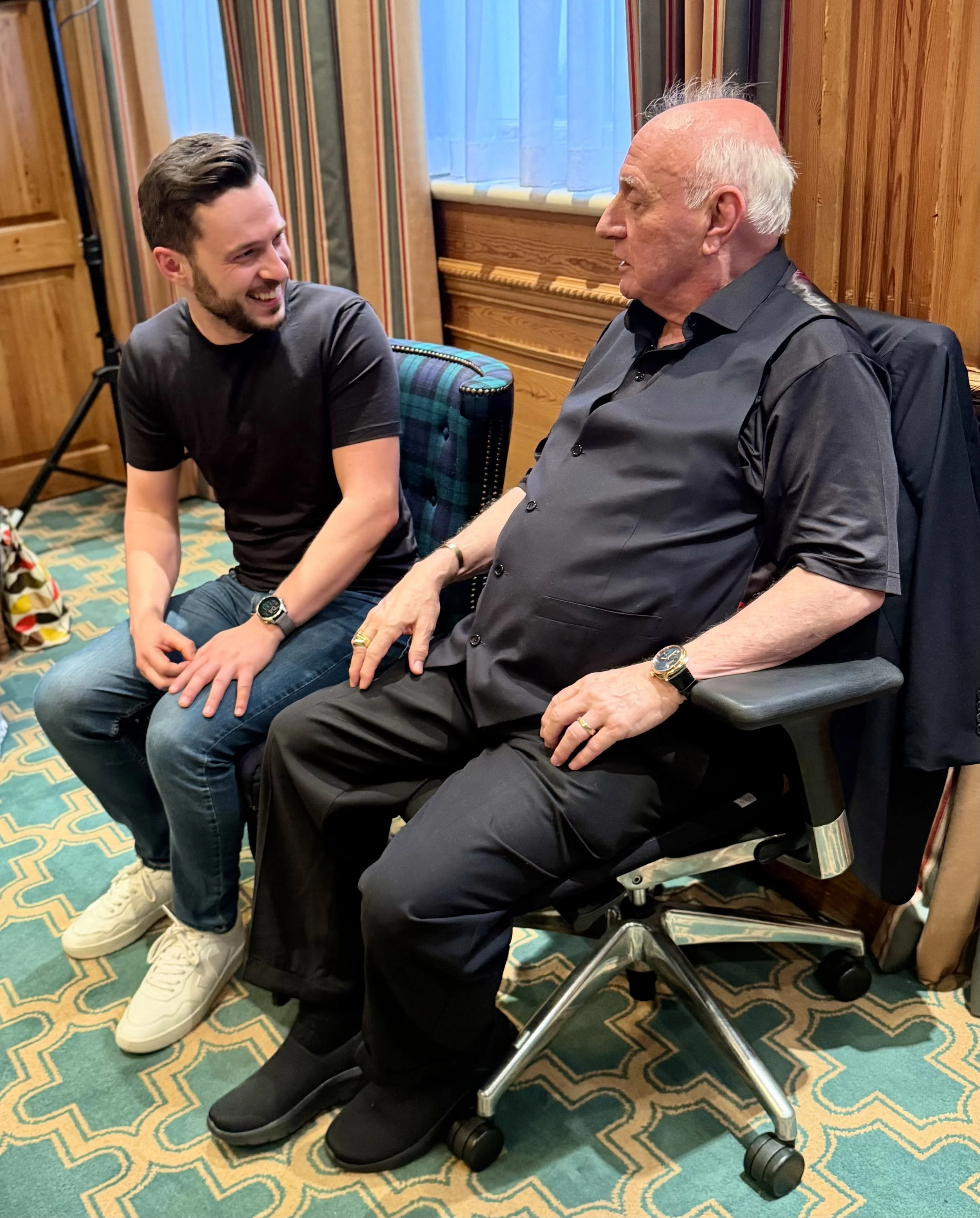
Reflecting on working with Richard Bandler
Chris reflects on attending Richard Bandler’s Personal Enhancement Workshop in May 2026. The post touches on personal growth, making big investments in yourself and trusting yourself to be in rooms that appear intimidating.
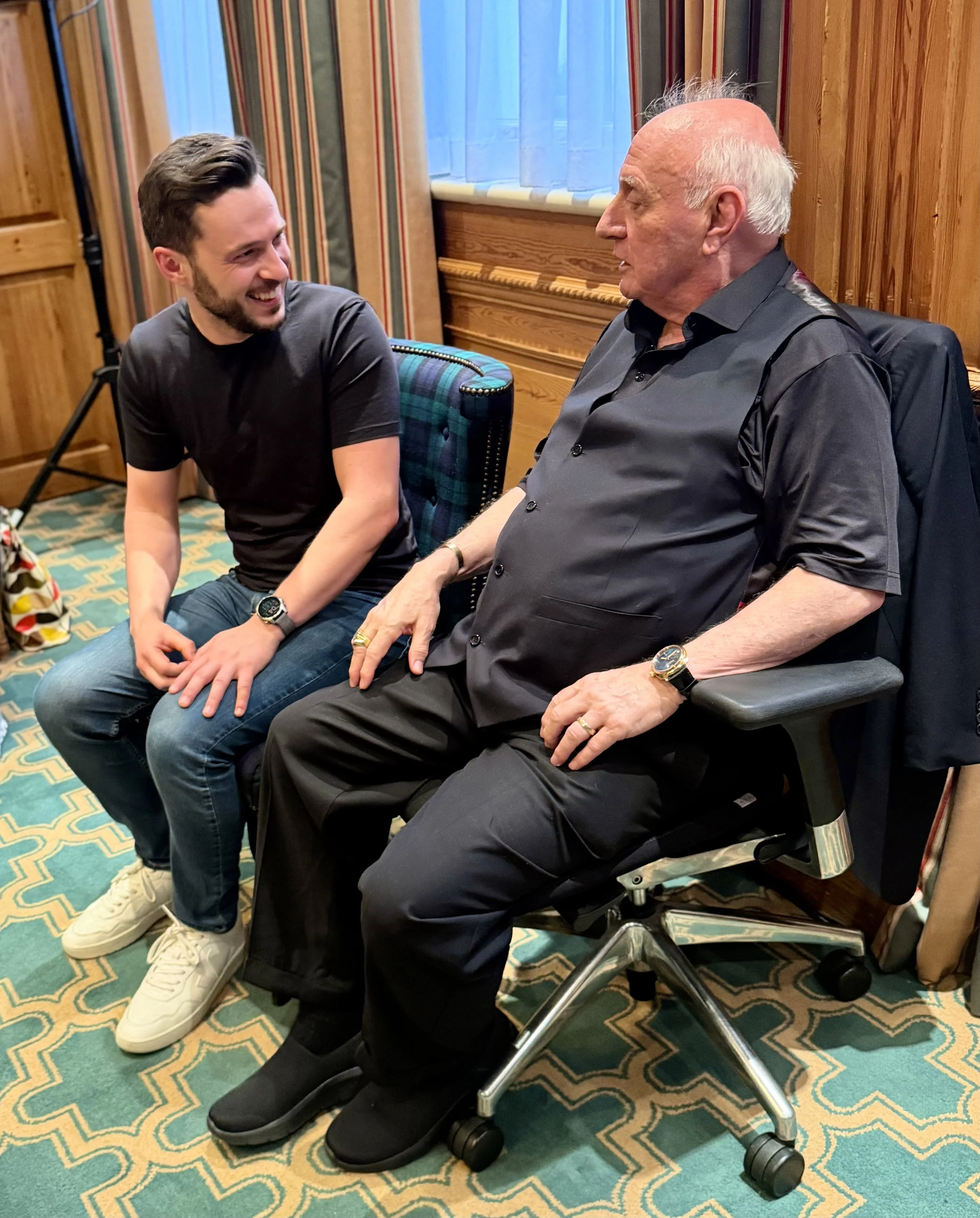
Richard Bandler’s Personal Enhancement Workshop in London, May 2026.
Dear past Chris.
You deserve to be in the room.
(Here’s the evidence).
Over the years I’ve invested in myself significantly.
After all, it’s not like we learn how to be a regulated adult in school.
May 2026 blew previous investments out of the water.
It cost 5x more than what I previously spent and it stung.
But that was the point.
I felt the vote of confidence towards myself.
Those who pay, pay attention.
And no one better to pay attention to.
Richard Bandler was in good form.
You may not have heard of him.
A lot of his work has been “borrowed” without acknowledgment.
Most people know Tony Robbins.
His empire is openly built on Richard’s work.
A man who questioned conventional talk therapy decades ago by asking:
Why does this take so long?
And that was the exact energy he brought into the room.
Razor sharp wit, an abundance of skill and his trademark humour.
I was wearing two hats:
The client and the student.
My goal in 2026 is to cut my stress levels by 50%.
Richard knew exactly how to help.
His skills are unquestionable.
His public reputation is not.
The internet labels his work pseudoscience.
People who need it most, are also most sceptical.
Believing no one can help them.
Having to stay in that limiting pattern forever.
“This is just who I am”.
I learned a lot about who I am in recent years.
Because I refused to put my limitations down to personality.
Ten years ago I would not have dreamed of being in that room.
Who am I to spend three days with Richard Bandler?
Now I have the answer.
I’m the guy who learned directly from him.
I grew both as a person and in my craft.
I invested significantly to be in that room.
I'd do it again.